AMD Radeon RX 9070 GRE review (Acer Nitro)
The AMD RX 9070 GRE is probably the most 2026 graphics card any GPU company could release this year. With the possible exception of Nvidia digging down the back of the sofa again and releasing another RTX 3060. The RX 9070 GRE was previously a China-exclusive card and represents a dumbing down of the Navi 48 GPU with l...
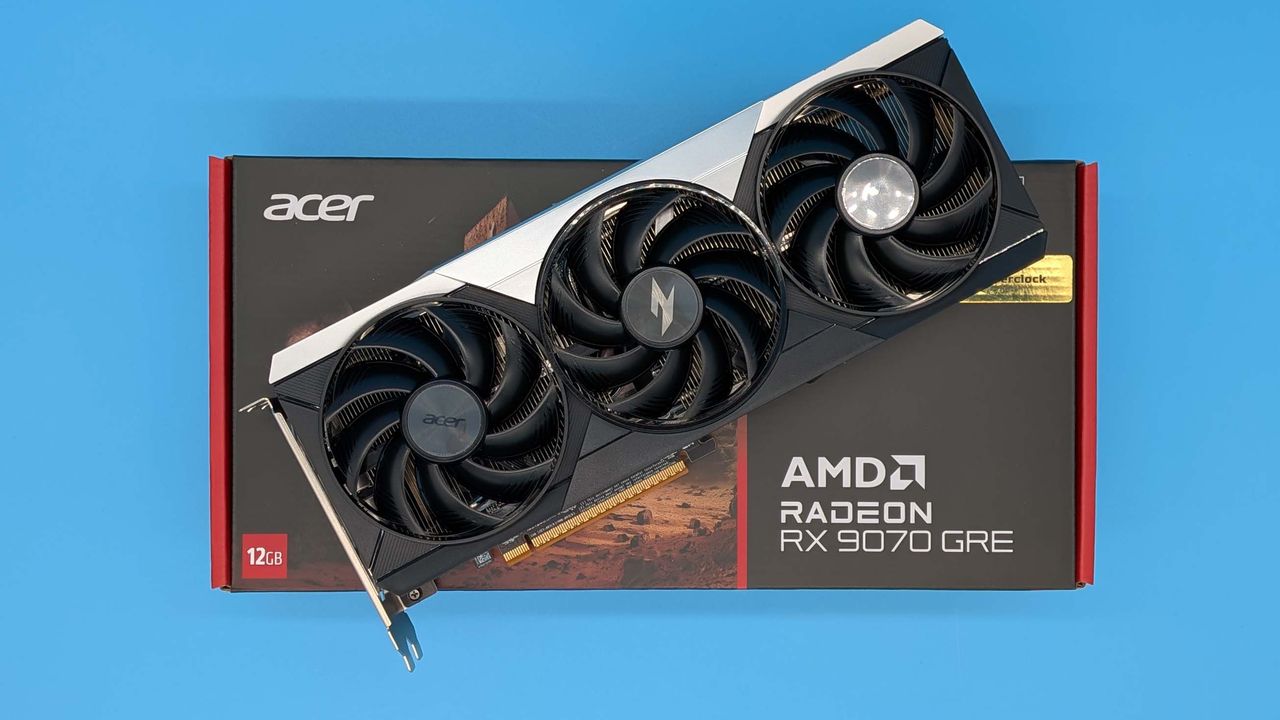
The AMD RX 9070 GRE is probably the most 2026 graphics card any GPU company could release this year. With the possible exception of Nvidia digging down the back of the sofa again and releasing another RTX 3060. The RX 9070 GRE was previously a China-exclusive card and represents a dumbing down of the Navi 48 GPU with less of that expensive ol' VRAM. But the most damning aspect is the fact AMD has given this weaker card a global release at the same starting price as the beefier RX 9070.
I get the rationale—because of memory and silicon constraints, graphics card prices are all higher than they were when this card originally launched in China—but still, releasing a weaker GPU at the same initial MSRP as another card, which has a more fully functional version of the same chip, is never going to feel good. It's becoming a common phrase for me, but this is just another damning indictment of the state of PC gaming hardware in 2026.
This is a card very much released for right now, giving AMD more options for its Navi 48 silicon (especially for chips that don't make the grade for full RX 9070/XT cards) without needing to offer the full 16 GB monty. And it is priced for right now, too, with Nvidia's RTX 5070 available at $600 and the RTX 5060 Ti 16 GB at $550. AMD is laser-focused on those two GeForce cards, but clearly also doesn't want to completely torpedo the RX 9070 by pricing it fully $100 lower at $499.
It is still an impressive card in its own right, getting mighty close to the RTX 5070 at stock speeds and regularly beating it with a simple, pain-free undervolt. So, while I'm not necessarily loving the optics of it being priced at the same MSRP as the unquestionably better RX 9070, it's the $550 card I would recommend right now, with the $50 delta between them being just enough. But if retailers lose their collective minds and regularly price it at the same level as the cheapest RX 9070 cards—which could absolutely happen, too—the RX 9070 GRE's value-proposition entirely evaporates.
✅ You can find it at or below MSRP: The RX 9070 GRE rapidly loses relevance as soon as it strays above its $549 price tag. With the superior RX 9070 costing $600 right now, there isn't a lot of wiggle room for retailers or manufacturers.
✅ You're happy tweaking: The extra level of performance you can extract from the RX 9070 GRE with some easy undervolting is tangible, and levels up the card.
❌ You can find the RX 9070 for the same price: With 16 GB of faster VRAM and a more powerful version of the Navi 48 GPU, the straight RX 9070 is easily the better card.
❌ You want compute power, too: The RDNA 4 architecture just doesn't have the same general compute performance as equivalent Nvidia GPUs. If you're rendering or hoping for a GenAI card, this is not the way.
Nipped and tucked, but RDNA 4 still delivers
Features 3.5 Group 1 Data ProductFeatures () RX 9070 GRE (Acer Nitro)3.5 window.iFrameResizer = { heightCalculationMethod: 'taggedElement' }; (function() { /* Global animation function for slideshow re-use */ window.fvAnimateCharts = function(chartWrapper) { if (!chartWrapper) return; function animateBars(chartElement) { if (!chartElement) return; var bars = chartElement.querySelectorAll('.fv-bar, .fv-stacked-segment'); bars.forEach(function(bar, index) { /* Reset to 0 first to ensure animation triggers */ bar.style.setProperty('width', '0%', 'important'); bar.style.setProperty('transition', 'none', 'important'); var targetWidth = bar.dataset.targetWidth; if (targetWidth === undefined) return; /* Force reflow */ void bar.offsetWidth; var targetMargin = bar.dataset.targetMargin; var baseMargin = bar.dataset.baseMargin; if (baseMargin !== undefined) { bar.style.setProperty('margin-left', baseMargin + '%', 'important'); } setTimeout(function() { var marginTransition = baseMargin !== undefined ? ', margin-left 0.8s ease-out' : ''; bar.style.setProperty('transition', 'opacity 0.2s ease, width 0.8s ease-out' + marginTransition, 'important'); bar.style.setProperty('width', targetWidth + '%', 'important'); if (targetMargin !== undefined && baseMargin !== undefined) { bar.style.setProperty('margin-left', targetMargin + '%', 'important'); } }, index * 50 + 50); /* Reduced initial delay */ }); } function animateLineChart(chartElement) { if (!chartElement) return; var lineSvg = chartElement.querySelector('svg'); if (!lineSvg) return; var paths = lineSvg.querySelectorAll('.riv-line-path'); paths.forEach(function(p, i) { if (typeof p.getTotalLength === 'function') { var len = p.getTotalLength(); p.style.transition = 'none'; p.style.strokeDasharray = len; p.style.strokeDashoffset = len; p.getBoundingClientRect(); setTimeout(function() { p.style.transition = 'stroke-dashoffset 1s ease-out ' + (i * 0.1) + 's, stroke-width 0.2s, opacity 0.2s'; p.style.strokeDashoffset = '0'; }, 100); } }); var dots = lineSvg.querySelectorAll('.riv-dot'); dots.forEach(function(dot, i) { dot.style.opacity = '0'; setTimeout(function() { dot.style.transition = 'opacity 0.3s ease'; dot.style.opacity = '1'; }, 500 + i * 10); }); } /* Execute */ var charts = chartWrapper.querySelectorAll('.fv-chart-item'); charts.forEach(function(chart) { /* If in carousel/dropdown mode, hidden charts are display:none. */ /* We only animate what is visible. */ if (window.getComputedStyle(chart).display === 'none') return; var chartType = chart.dataset.chartType; if (chartType === 'Line') { animateLineChart(chart); } else if (chartType !== 'Pie') { animateBars(chart); } }); }; function initialize(uniqueId, isSlideshow) { var root = document.getElementById(uniqueId); /* In slideshow mode, 'root' will be null because the container has '-slideshow' suffix. */ /* We handle that logic below. */ if (!root && !isSlideshow) return; /* Setup internal interactions (Carousel/Dropdown/LineChart) for a specific chart wrapper */ function setupWrapper(chartWrapper) { if (!chartWrapper) return; /* Responsive mobile view handling */ function checkMobileView() { var width = chartWrapper.getBoundingClientRect().width; var isMobileDevice = window.screen && Math.min(window.screen.width, window.screen.height)Original reporting appears on the publisher’s site.
Open original article →