007: Nightfire review (2003)
Special commentary on this classic PC Gamer review provided by: 007: Nightfire review - PC Gamer issue #107 (US, February 2003)From the archives: The review below appears as originally written, with only minor changes in formatting a...
Special commentary on this classic PC Gamer review provided by:
007: Nightfire review - PC Gamer issue #107 (US, February 2003)
From the archives: The review below appears as originally written, with only minor changes in formatting and newly taken screenshots. By Chuck Osborn
It’s an irony that only a master criminal being devoured alive by his own bionic piranha could savor—that No One Lives Forever and its sequel, jaunty pokes-in-the-eye at the Bond movie franchise, are far better games than one starring the venerable superspy himself.
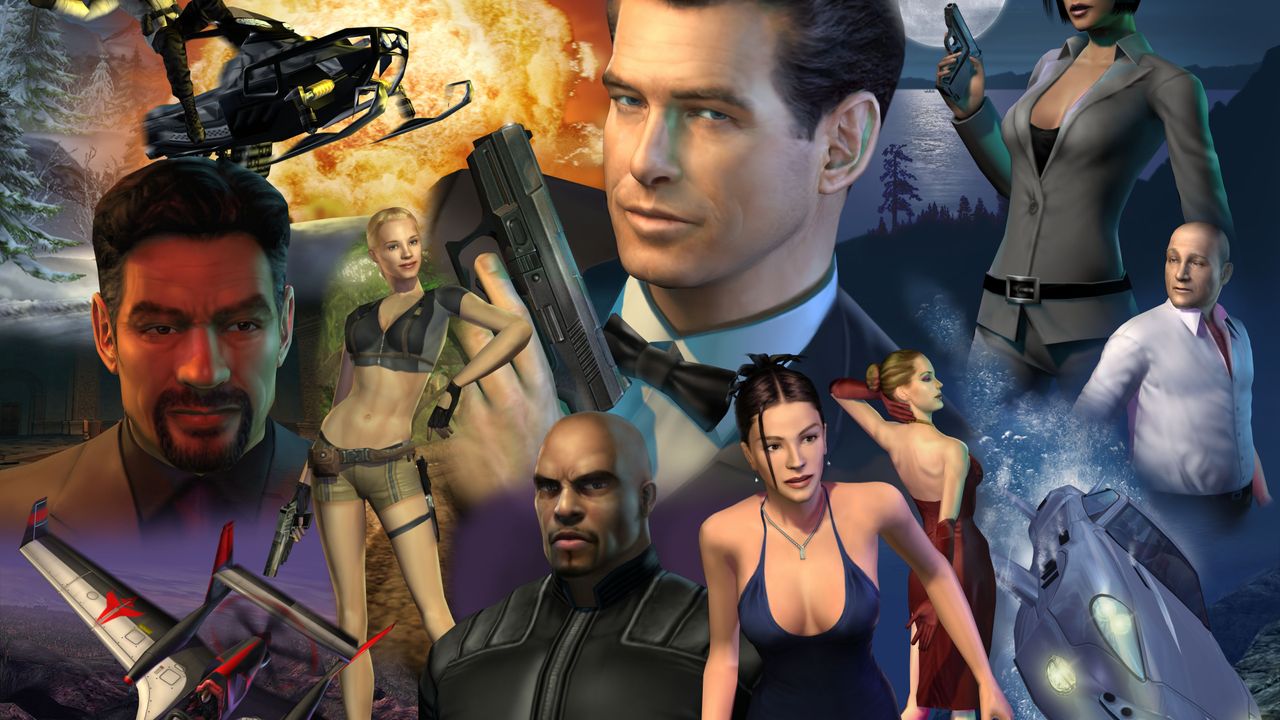
In Nightfire, you’re James Bond, Britain’s MI6 playboy secret agent. Sophisticated, suave, cocksure—in this first-person shooter, you’re none of these things. You see, I discovered the game’s secret—you’re not Bond, you’re M’s gun valet: a stunt double who shoots the bad guys while the Pierce Brosnan–modeled 007 (who sounds more like George Lazenby) has all the fun during the game’s tortured cinematic cutscenes.
On Her Majesty's secret 007th circle of hell is forever
Before launching the game, you’re treated to one of the title’s high points—an introductory sequence modeled on the opening vignettes from the Bond films, complete with sexy power ballad. The intent, of course—from the appearance of the MGM lion to the blazing female figures somersaulting across your monitor screen—is to relay the message that Nightfire’s original storyline is a thrilling cinematic adventure so tantalizing that it could be splashed on the big screen.
But the game’s nine missions are actually a skeleton strung together by disjointed clichés. True, these are the clichés we’ve come to know and love—guns, girls, and gadgets—but they’re presented with a perfunctory half-hearted yawn rather than silver-screen sizzle.
The head of Britain’s secret service, M (obviously not voiced by Dame Judi Dench), has entreated you to investigate Rafael Drake, a slick industrialist and utterly forgettable evil super-genius who heads the Phoenix International Corporation. He’s acquired some nuclear missiles and… well, frankly, he could be using them as giant pointy paperweights for all I know: Nightfire isn’t big on coherent storytelling. What I do know is that you have to stop him by attending a fancy dress party, infiltrate his secret underwater lair, and eventually blast off into outer space.
Now wait—that sounds a lot cooler than it actually plays. Nightfire is loaded with such sloppy bugs and rotten AI that I honestly believe Rafael Drake’s first act of villainy was to eliminate the EA play-testing department.
From the first level, my attempt to crash a party with spy-chic stealth went pear-shaped: Merely touching the side of a truck bound for Drake’s Austrian mountaintop castle bounced me back like a rubber Bond, sending me careening off a cliff to my death. And even though I’d blasted numerous guards with deafening automatic-weapons fire, and done so unmasked, I was welcomed into the soiree with open arms.
Next, M commands me to discretely photograph the slinky sex kittens in attendance (not her words) with my Q-issued cigarette lighter-slash-minicamera. (You wield a variety of gadgets throughout the game, such as pen-darts, a laser-watch, and very cool X-ray specs.) Here, another bug: multiple camera shots were required before the mission objective would register as completed.
Keep in mind that each of these irksome glitches occurred within the first 30 minutes of gameplay. Individually, they’re annoying; in sequence like this, they’re downright frustrating.
The spy who bored me
Including his trusty Wolfram P2K pistol (with optional silencer), Bond can carry up to four firearms at one time—machine guns, sniper rifles, missile launchers, and a massive shoulder cannon among them. (It’s surprising you don’t jingle like a charm bracelet while sneaking around.)
You can also load up on frag and flashbang grenades, tripmines, and body armor. You’ll find the latter lying on desks or in stairwells, and sometimes inside padlocked chests and lockers that can be broken into using your laser watch.
Objectives are relayed to you by M or by lovely allies like the alluring Alura McCall and secret agent Zoe Nightshade, a holdover from Agent Under Fire, a console game that never made its way to the PC. Unfortunately, these goals—blowing up a computer, setting charges on the base of a bridge, and so on—seem pretty straightforward and arbitrary. You have a license to kill, but little license to exercise creative problem-solving à la the forthcoming Splinter Cell.
The appeal of a James Bond game, Bond being Bond, is in the rendered cinematics: trading double-entendres with the ladies, parachuting out of danger, and driving your Q-rigged Aston Martin. Unfortunately, a driving mode was jettisoned from Nightfire’s PC version, though it remains in the console iterations.
For your AI only
From the archivesThis review was originally published in PC Gamer #107 (US, February 2003).
You can still subscribe to PC Gamer to get new issues of the magazine (in print!) every month.
Nightfire has some of the worst AI I’ve ever seen in a big-budget game release. Guards are idiot savants—incapable of hearing a firefight in the next room or noticing that a nearby co-worker just had his head blown off, yet able to zero in on you immediately as soon as you enter their radius of fire (in one case, even while Bond was hidden inside an air vent).
The bipolar AI makes certain levels particularly grating, especially the forced-stealth “alert the guards and fail” missions. And though the manual suggests you should “shoot out overhead lights to remain hidden in the shadows,” a whopping none of the lights I shot ever broke.
That’s okay, because all the enemies are apparently laminated in bulletproof shielding. The damage model is dodgy, contrarily letting you get off a one-shot kill to the head using your sniper rifle while five pistol rounds to the face will barely make a bad guy flinch. Boss battles are likewise uninspired. There are four bosses—a ninja, a lasergun-toting underwater henchman, two ninjas, and then Drake himself, wielding the same lasergun but now out in space. Running away and shooting is the method for beating each one.
Views to a kill
So what is there to like about Nightfire? Well, if it was a movie, the set design would win an Oscar. Missions take place in a variety of minutely detailed environments, from a countryside paper-walled Japanese estate to cluttered rocket-ship hangars to Drake’s opulent chandeliered inner sanctum.
A few sequences showed promise, such as one part where you’re trapped inside a dangling elevator and have to snipe enemies before they can shoot through the cable that’s holding you up. Infiltrating Drake’s island facility was fun, too, mainly because, unlike in some other levels, I was given more latitude in choosing stealth versus brute force. (Though I would’ve liked the ability to knock out a jump-suited goon and steal his clothing.)
The multiplayer game is merely okay, offering deathmatch, team deathmatch, and CTF modes. Some classic Bond villains (Jaws, Oddjob) and girls (Christmas Jones) are selectable skins, but the likenesses are hit-and-miss. Scaramunga, for example, looks as much like Christopher Lee as I do.
For a rollicking good spy caper, Cate Archer’s NOLF 2 definitely holds the upper hand this round. Nightfire’s Bond is just bland. James Bland.
Original reporting appears on the publisher’s site.
Open original article →