
Valve had next-gen VR 'headsets ready three, four years ago and they were big, bulky devices' but went back to the drawing board after actually putting them on
The Steam Frame is here and it's one of the best VR headsets I've ever had attached to my face, just don't ask me about the price. But when we spoke to two of the people at Valve who helped create the device—Joy Lyons and Jeremy Selan—they told me the company actually had its new VR headsets ready years ago, but they m...
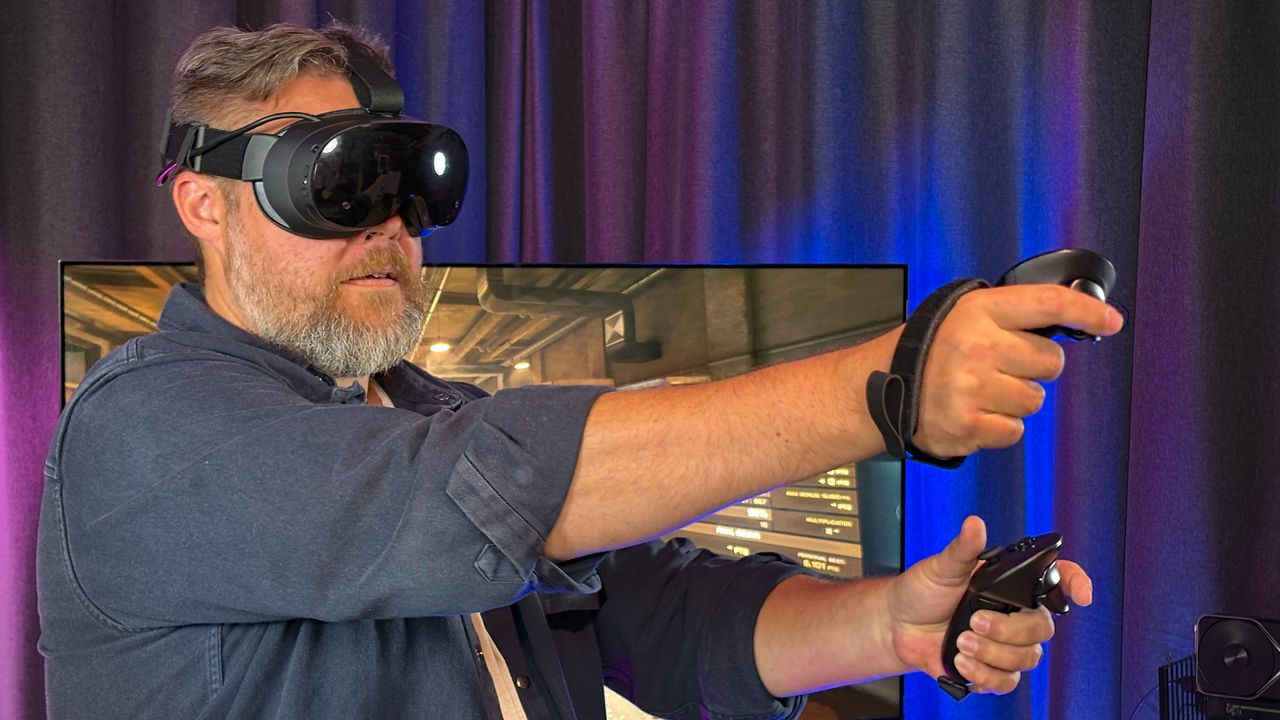
The Steam Frame is here and it's one of the best VR headsets I've ever had attached to my face, just don't ask me about the price. But when we spoke to two of the people at Valve who helped create the device—Joy Lyons and Jeremy Selan—they told me the company actually had its new VR headsets ready years ago, but they made the tough decision to pull the plug on those designs.
"We had the headsets ready three, four years ago," Selan explains, "and they were big, bulky devices. They were more in the style of the Valve Index, and we put them on, and we're just like, this doesn't feel like what we would want the next round of our product to be."
We'd asked why now, why is this the right time to release a new VR headset? With sales dropping year over year and 2026 potentially being the worst year effectively since records began for PCVR releases, it doesn't necessarily seem like the perfect time to be putting out new virtual reality hardware, and that's before we even mention the memory and hardware pricing crisis.
"You asked, why now?" says Selan. "The answer with all Valve projects is 'as soon as we can'. Right, this was the soonest we could release the headset, but we had to make sure it was ready.
"The hardware engineers went back to the drawing board many, many times to finally achieve sort of the very small form factor, the comfortable, the lightweight. Figuring out all the system trade-offs with regards to power versus battery weight, versus cooling, and thermals. So this was absolutely the fastest we were capable of shipping the device that we were proud of.
"Now we thought that was going to be early 2026, and it turns out due to supply and component shortages and economics that in fact now was the soonest we could release it."
But it's not just about the hardware. As Valve engineer Joy Lyons notes, "The focus was on being lightweight and being comfortable", but while it's the hardware that makes that possible, all of the work Valve has been putting in with its previous releases on the software side have made this headset the one that actually gets released.
"We learned a lot with our portable systems," Lyons explains, "including the Steam Deck launch and all the work we did for emulation and the operating system, with Proton being able to run Windows-based games on Linux, on the SteamOS operating system.
"And so we've been continuing that work, and now we've got an ARM device, and so we think this is a great time to take advantage of Proton, being able to do FEX, which allows us to run x86 games on a piece of ARM hardware, and Lepton, which is the new work to do Android-based games, and have that work also on our SteamOS platform. And so we're able to have all these come together, as well as all of our work on the hardware side."
It's this kind of VR nexus point which has made the Steam Frame the right device for Valve, and at the right time. It is, of course, a PC VR device, with its almost uncanny ability to stream games wirelessly from your PC utterly seamlessly, but it is also a standalone device able to translate your x86 PC's Steam library and have that run inside an ARM-based VR headset. Again, almost seamlessly.
And then you also now have the ability to play Android games through Steam via the Lepton translation layer. Now, that's not just Candy Crush writ large on a massive virtual screen, this is specifically designed to capture the wealth of VR content released for the Meta Quest and its Android-based Horizon OS. And with this new world of potential content available to the Steam Frame as a portable device, it's been a bit of a journey of discovery even for Valve.
"I'm like, 'I wonder if this one will run?'" says Lyons. "And you download it, and you open it, and it runs, and you put it on the huge screen. That was the moment where it's just like, 'this is fun. I'm gonna take off my engineer hat. I'm gonna stop nitpicking every little thing that I know about the device, and I'll definitely address that tomorrow. But right now, I'm actually having fun.'
"I think I went through 89 games in a two week period… that's kind of the moment where it's like, 'yeah, this is great'."
"We're our own best testers," adds Selan. "So I do remember in those days I would have access to this secret prototype VR hardware, and I would take it home… and I'd still use my Steam Deck.
"And there became a transition point with this round of hardware, where when I took this home and this was my favorite device to use. And so, for me personally, that's when sort of a switch flipped in my head, and I was like, 'This is going to be a real thing'."
Steam Frame: Valve's new wireless VR headset
Steam Machine: Compact living room gaming box
Steam Controller: A controller to replace your mouseView Deal
Original reporting appears on the publisher’s site.
Open original article →

