Sony Inzone M10S II review
Until now, every OLED gaming monitor we've reviewed has been rated at 0.03 ms for pixel response. Well, not any more ladies and germs. Give it up for the new Sony Inzone M10S II, which clocks in at a mere 0.02 ms.Is it a bit of a stretch to think the human eye can tell the difference between three one-hundred-thousandt...
Until now, every OLED gaming monitor we've reviewed has been rated at 0.03 ms for pixel response. Well, not any more ladies and germs. Give it up for the new Sony Inzone M10S II, which clocks in at a mere 0.02 ms.
Is it a bit of a stretch to think the human eye can tell the difference between three one-hundred-thousandths of a second and two one-hundred-thousandths—or 30 microseconds and 20 microseconds, if you prefer. But the point here is what that pixel response spec hints at.
The Sony Inzone M10S II is unambiguously, unashamedly, unapologetically aimed at fast-paced gaming and esports. Indeed, this monitor has been developed with the help of pro esports outfit, Fnatic.
Sony Inzone M10S II specsScreen size
27-inch
Resolution
2,560 x 1,440
Brightness
335 nits full screen, 1,500 peak HDR 1% APL
Response time
0.02 ms
Refresh rate
540 Hz @ 1440p, 720 Hz @ 720p
HDR
DisplayHDR True Black 500
Features
LG Tandem WOLED panel, 2x HDMI 2.1, DisplayPort 2.1, USB-A hub, 3.5mm audio
Price
Buy if...
✅ You're a speed freak: With a 540 Hz refresh rate and 0.02 ms pixel response, this is one of the fastest monitors on the planet.
Do not buy if...
❌ You want a cinematic experience: At 27 inches, the Sony Inzone M10S II isn't puny. But at this price point, 39-inch 5K2K OLEDs are available.
Along with the almost pointlessly fast pixel response, you get a 1440p native resolution and 540 Hz refresh. Oh, and we're talking 27 inches and an LG WOLED panel. That basic recipe of 27-inch 1440p OLED is carried over from the first generation Sony Inzone M10S, but this time Sony is using the latest LG Tandem WOLED panel generation.
The most obvious upside of that panel involves brightness. Sony has this model pegged at 1,500 nits peak HDR and 335 nits full-screen brightness. Those numbers are about as good as gaming OLEDs get, today.
They also indicate that this is an RGWB panel rather than one with the so-called pure RGB-stripe subpixel structure we've seen monitors like the Alienware AW3926QW and Asus ROG Swift PG32UCWM. We'll come back to the implications of that in a bit.
Further gaming centric features include the image processing trifecta of dual-mode support, motion blur reduction and anti VRR flicker tech. The dual-mode options include both 24.5-inch modes and a 720 Hz 720p mode.
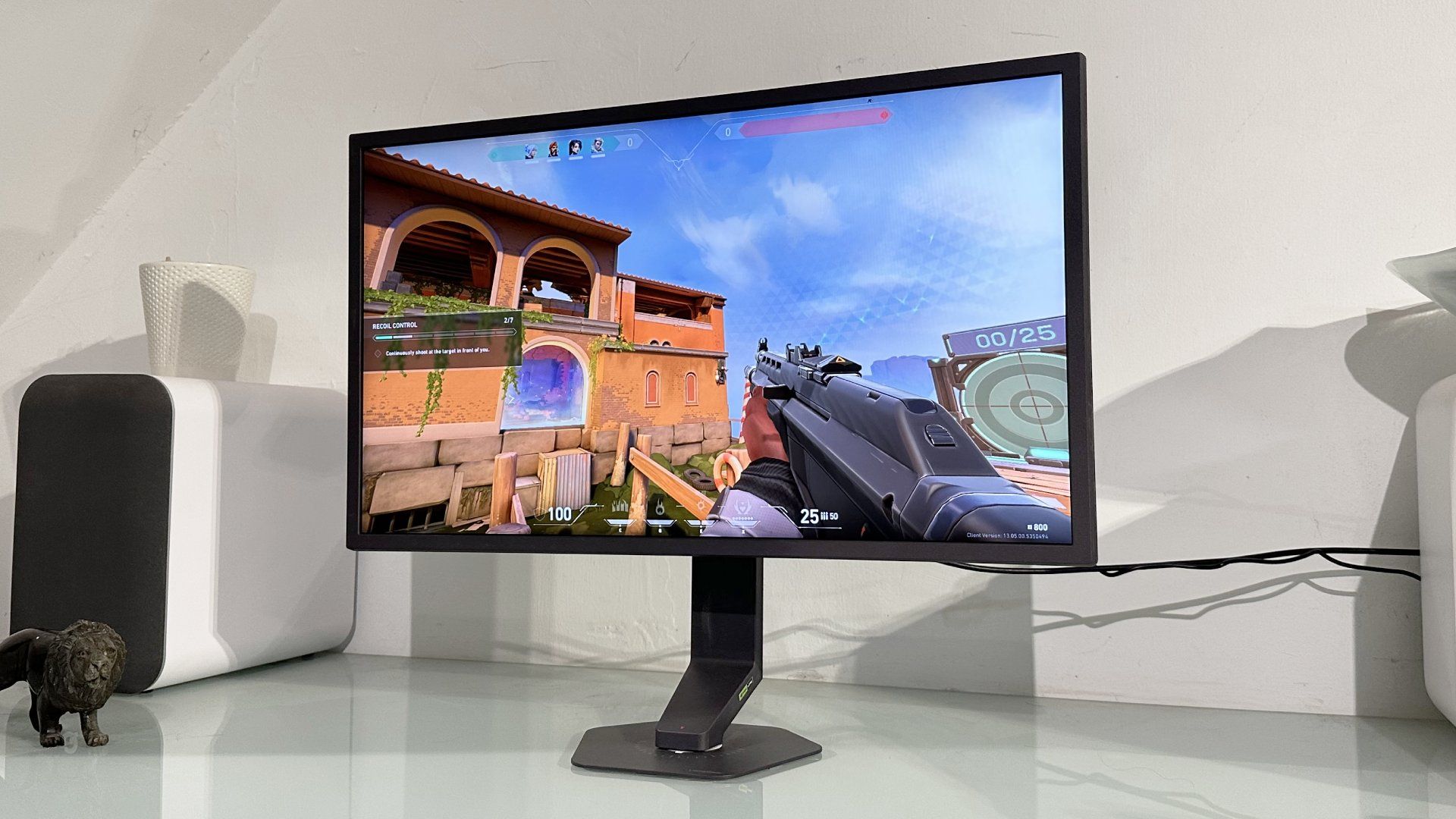
Actually, even the stand has been optimised for gaming. For starters, the round base is absolutely tiny. You might think that makes for an unstable monitor. But provided you place it on a flat, hard surface, it's rock solid, while leaving minimising intrusion into your desk space. In classic Sony style, it also looks and feels expensive in a way that very few monitors manage.
What's more, the tilt adjustment allows for 35 degrees of upwards movement. Some pro gamers like to tilt their monitors aggressively and then shove their faces right into the panel. If that's something you want to emulate, well, the Sony Inzone M10S II will cater for that right out of the box. You won't need to buy an aftermarket VESA stand.
Connectivity, meanwhile, includes HDMI and DisplayPort, but there's no USB-C for single-cable connectivity to a laptop. Obviously, this is an out-and-out gaming panel, so USB-C connectivity isn't automatically a high priority. But at this price point, it seems like something of an omission.
Oh, yeah, I hadn't mentioned the price, had I? The Sony Inzone M10S II weighs in at $1,099 in the USA and £1,199 in the UK. Yup, that's mega money and it emphasises just what a premium has been placed on achieving the 540 Hz and 0.02 ms speed.
You are paying dearly for the Sony Inzone M10S II's refresh rate and response performance, that's for sure.
Both of those fancy RGB-stripe OLEDs I mentioned earlier from Alienware and Asus can be had for similar money. One is a 39-inch 5K2K panel, the other a 32-inch 4K model. In short, you are paying dearly for the Sony Inzone M10S II's refresh rate and response performance.
Just to round everything out before we get to what this thing actually looks like, Sony has gone for a matte anti-glare coating as opposed to glossy. Again, this arguably squares with the tight focus on esports over optimising for the last word in contrast and HDR image quality. Finally, the panel is covered by a three-year warranty, including OLED burn-in.
On, then, to the actual performance. Out of the box and the first thing you notice is that matte anti-glare coating. By today's standards, it's properly matte as opposed to the semi-glossy coating that most "matte" panels have these days.
That has an immediate impact on the look of the display. Subjectively, it's not as contrasty and saturated as most OLED monitors. The upside is that reflections are suppressed really well, especially in bright ambient light. But it does slightly undermine the immediate impact of an OLED monitor.
The RGWB subpixel structure feeds into that somewhat. This is certainly a very bright monitor for an OLED as the specs imply. But as with all RGWB panels, the colour saturation isn't all that great, so it doesn't seem quite as vibrant as a monitor using Samsung's QD-OLED tech or arguably even the technically less-bright alternative LG Tandem WOLED panel tech with the RGB-stripe structure.
But the speed, there's absolutely no problem with the speed. I recently reviewed LG's new 1,000 Hz IPS monitor, the 1080p one with the clunky pixel density but mega low latency. For motion sharpness, this 540 Hz OLED frankly tears it a new one. This monitor has the best motion clarity I have ever seen, it's absolutely fantastic.
The Sony Inzone M10S II is just lightning quick, both in terms of pixel response and latency.
What's more, as I found with that LG monitor, actually achieving the in-game frame rates required to saturate 1,000 Hz refresh isn't easy. I couldn't get near that in Counter-Strike 2, for instance. So, in terms of latency, you could argue that going beyond the 540 Hz offered by this Sony panel is pretty pointless. Well, it is until AMD or Intel release a CPU that'll do 1,000 Hz in most esports titles without the need for liquid nitrogen cooling.
Anywho, the Sony Inzone M10S II is just lightning quick, both in terms of pixel response and latency. It also offers 24.5-inch modes in both native 2,368-by-1,332 pixel and 1080p resolutions. And because this is an OLED, the unused area of the panel around the 24.5-inch image is completely off, not bleeding light in a distracting fashion.
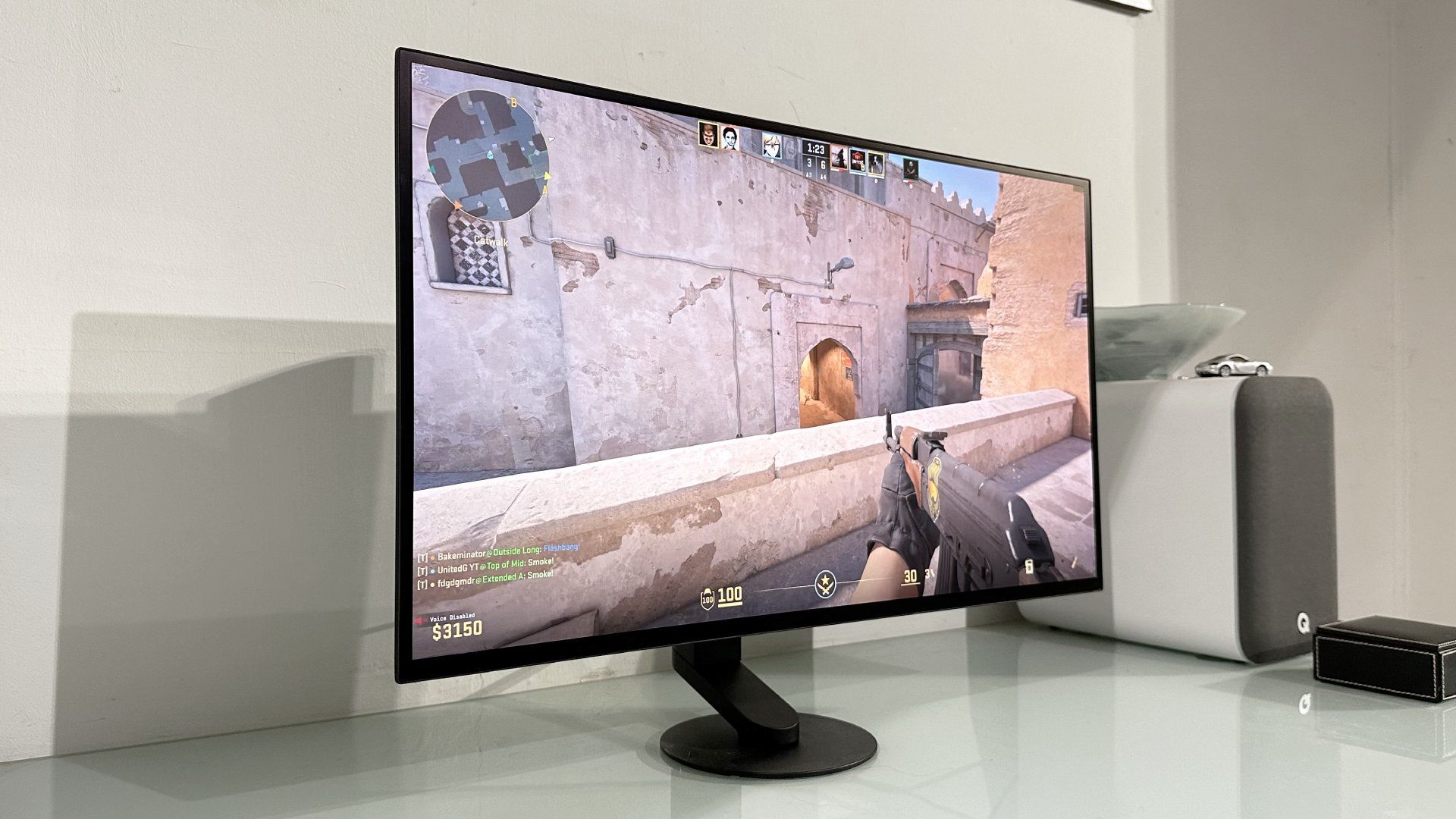
All of that means I'd take this 540 Hz Sony over the 1,000 Hz LG all day long for esports, it's absolutely fantastic for my esports distraction of choice, Counter-Strike 2, let alone general gaming and computing. And I think even pro gamers would, too. Partly that's because of the real-world limitations around frame rates I just mentioned. But it's also because the image quality on offer here is so much better.
When it comes to spotting enemies, motion clarity and contrast matter and this Sony absolutely owns the LG IPS monitor. The inclusion of the 24.5-inch dual-mode options only makes the serious esports proposition even stronger.
I'd take this 540 Hz Sony over the 1,000 Hz LG all day long for esports.
On that note, Sony has included a couple of FPS Pro presets which accentuate the contrast even further and make red tones more vibrant. The latter is handy in games like Valorant where enemies are outlined with a bright red border.
To cover off a few of the other gaming-centric features, what about the Motion Blur Reduction and anti-VRR Flicker modes? The former does an impressive job of effectively making 270 Hz look about as clear as 540 Hz.
It basically works by inserting a black frame in between each rendered frame, effectively halving the refresh rate from 540 Hz to 270 Hz. It does reduce brightness noticeably, but not catastrophically. I think for esports titles where you're not getting anywhere near 500-plus fps, it could come in handy for maximising motion clarity.
As for the anti-VRR Flicker tech, well, that was a bit of an odd one, albeit in a positive way. No matter what game I loaded and regardless of both in-game and monitor settings, I couldn't detect any VRR flicker at all on this monitor. Where it gets odd is that this was true whether or not I had the anti-VRR Flicker feature enabled or not.
Whatever, the Sony Inzone M10S II is unquestionably an outstanding gaming monitor. Not only is it dramatically more versatile for all kinds of gaming than a 25-inch 1080p monitor thanks to its larger 27-inch panel and half-decent 1440p pixel density. I think it's actually preferable for the ultra-narrow remit of really serious esports, too. It has better motion clarity, far superior contrast and the real-world latency gap is probably negligible.
Of course, in a broader gaming and computing remit, the Sony Inzone M10S II doesn't look like a great deal. Not when you can get a really nice 32-inch 4K OLED for far less money and a fabulous 39-inch 5K2K for the same investment. But that obvious caveat aside, and assuming you are okay with a matte as opposed to glossy OLED, this is one of if not the best ultra-high-refresh gaming monitors currently available. It's really, really, super.
Original reporting appears on the publisher’s site.
Open original article →