
A long-overdue conversation with Jordan Mechner
When I started working at PC Gamer in 2014, I began what I didn't realize at the time would become a bit of a ritual. A few weeks before the San Francisco Game Developer's Conference that year, I sent the creator of one of PC gaming's first masterpieces, Prince of Persia, an email asking if he'd be in town. Jordan Mech...
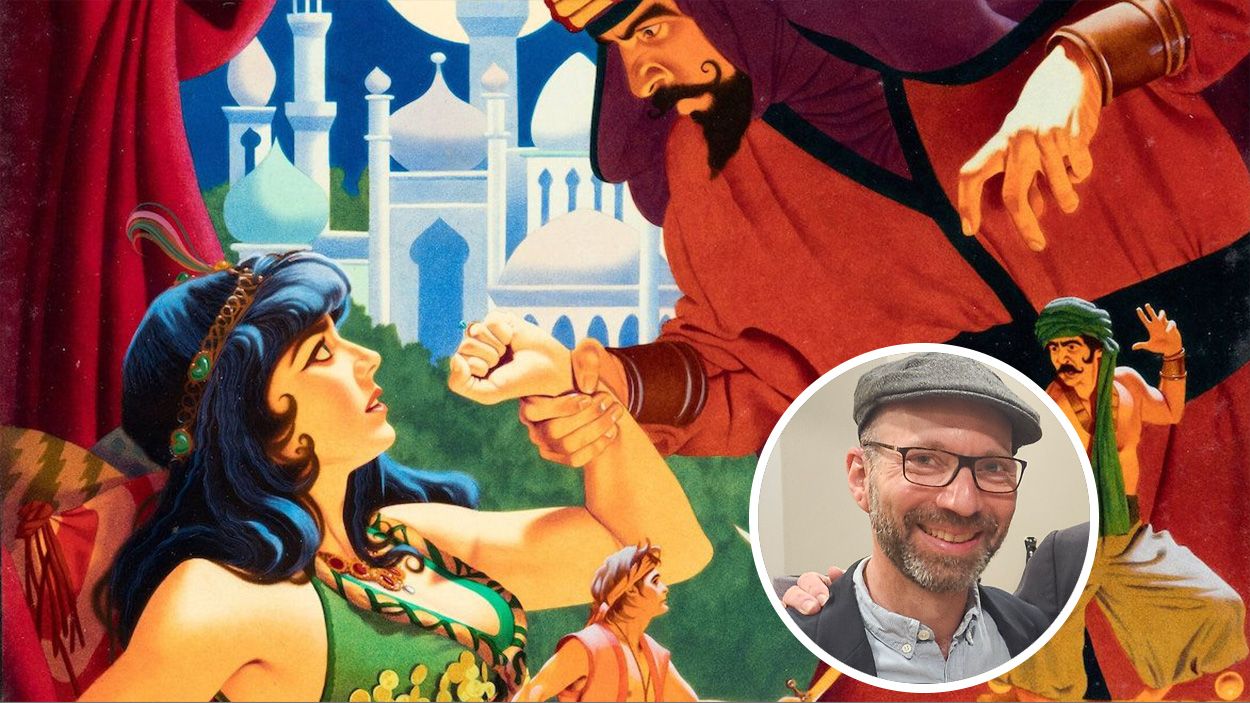
When I started working at PC Gamer in 2014, I began what I didn't realize at the time would become a bit of a ritual. A few weeks before the San Francisco Game Developer's Conference that year, I sent the creator of one of PC gaming's first masterpieces, Prince of Persia, an email asking if he'd be in town. Jordan Mechner politely responded that he wouldn't be making the trip from his home in Paris to San Francisco that year. But I kept trying when the conference rolled back around, thinking maybe this would be the year the stars aligned.
It took a decade, but in 2024 we finally made it happen: Mechner joined a roundtable I hosted alongside other veterans from designing PC games in the '80s and '90s to explore their long careers. Afterward, we talked some more just one-on-oneâbut in the busy aftermath of the conference, that interview never ended up making its way online.
So here it is now, covering his autobiographical graphic novel, why we may not have seen the last of adventure game The Last Express, and how every generation of fans now has its "own" Prince of Persia.
The many princes of Persia
When this interview was conducted, Ubisoft hadn't yet canceled its remake of Prince of Persia: The Sands of Time, which would've been the first new 3D game in the series in 15 years. The latest 2D game, The Lost Crown, was still fresh, and would be followed not long after our conversation by another 2D game, The Rogue Prince of Persia.
PC Gamer: It's interesting to see different visions of the Prince existing simultaneously now, though obviously Prince of Persia has evolved many times over its history.
Jordan Mechner: I think the Montpellier team made really smart choices with The Lost Crown, and doing Prince of Persia as a 2D Metroidvania, with an emphasis on the fantastic elements and the visual style that harks back to anime. It's also reminiscent of the early 2D Prince of Persia games and of the first Sands of Time.
Even fans of the 2008 Prince of Persia, I think, will find in the mythology and a lot of visual elements things that will make this feel like a Prince of Persia game to them in the best way. With no risk of it being confused with a photorealistic, fully 3D AAA Sands of Time-type game.
I loved the 2008 Prince of Persia. That game got a bad rap: People were like 'it plays itself. You don't have to do anything.' But I thought the fluidity of the movement in that game was just incredible. I loved it.
It's incredible to be part of something that's had so many lives.
Jordan Mechner
And the visuals are absolutely beautiful. There's, there's a lot to like about the 2008 Prince of Persia, and from my vantage point, from what I hear from fans, it has its own devoted, passionate following. Just as much as the Sands of Time trilogy, or the original 2D game.
That's the funny thing about Prince of Persia: That these constituencies are so separate, that there's all three of those. And then there's the Prince of Persia movie, because for many people, especially people who are around 30 years old today, the Prince of Persia movie is Prince of Persia for them, because they weren't the right age to have played any of the games.
There's a new generation of gamers for whom The Lost Crown will be the first Prince of Persia they encounter. It's incredible to be part of something that's had so many lives.
It's slightly surreal for me to hear you say the word 'Metroidvania' because it's such a gamer genre, but it also didn't exist when you made the original.
Of course, I made Prince of Persia about the same time that Metroid and Castlevania were being made. So it's a term that didn't exist, and we didn't have genres in those days in the sense that we do now. I think all of these we would have called platform games or action adventure games.
I don't know if you played Castlevania: Symphony of the Night, or some other version of a Metroidvania? What did it feel like for you having made a platformer that set a lot of precedents, and seeing that genre evolving over the years?
I've never been a Metroidvania playerâI would say Prince of Persia: The Lost Crown is actually the first Metroidvania game that I've played and really gotten into as a player. And I'm just enjoying it so much. As a 2d gamer, games that stand out to me are Inside and Limbo, which I thought were really beautiful. I also enjoyed some of the recent Rayman games.
Do you remember much about Prince of Persia 3D? Did you work on that game or consult on that game at all?
That was an internal Broderbund project. So I wasn't on the team, but I knew them.
I had been at Broderbund when I was making Prince of Persia 2: The Shadow and the Flame, which was my last, Broderbund Prince of Persia game. After that I had the idea to do a third episode of the trilogy in 2D. But this was 1993, tthe year of Doom and online multiplayer shooters, and so doing a 2D game just kind of didn't excite publishers, the way it had a year earlier.
So instead of that, I created Smoking Car Productions and The Last Express. While we were making The Last Express, Broderbund, then I think partly looking at Tomb Raider, came around to the idea of doing Prince of Persia as a 3D game. I wasn't involved, but wished them well. And they kept me in the loop.
Do you remember playing that one?
I played the first two levels. It was on PC, and I was a Mac gamer. So it wasn't really my genre, I didn't have a PC that was powerful enough to really enjoy it. So I only saw a bit of it.
Today I hear surprisingly often from gamers that they really enjoyed Prince of Persia 3D and have fond memories of it. So we should probably add that to the list of versions of Prince of Persia that each have their little camp.
I've never played it, but I'm really curious now to go back. It sounds like there wasn't anything you took directly from it. But I'm curious what was going on in that time between Prince of Persia 3D coming out, and you making your own 3D version with Sands of Time?
When I saw Tomb Raider I I was impressed. It blew my mind: it was the first third-person real-time 3D game I'd seen. I was making The Last Express at the time, which was a very different kind of game. But seeing Tomb Raider, I thought 'well we don't need to do Prince of Persia in 3D now. They've just done it. And it's great.'
But seeing Tomb Raider, and then seeing Prince of Persia 3D a few years later, my feeling as a gamer was that I missed the speed and fluidity of 2d gaming. Advancing up to the edge of a block and trying to point yourself in the right direction, and then missing the jump, as a gamer I just had more fun playing the 2D games. Of course, this was a stage in the evolution of 3D. So when I met the Ubisoft Montreal team in 2002, and they pitched the idea of doing a Prince of Persia for the PlayStation 2 generation, my first reservation was, 'how well is this going to work in 3D?'
The decision, from Sands of Time to Warrior Withinâthe mandate to change it from Teen to M was a marketing mandate. It wasn't the team's idea.
Jordan Mechner
That reservation was blown away when I saw the first animation tests and had the chance to meet the team and we all got excited about the possibility of taking the action vertical, and using parkour and these sort of Cirque du Soleil acrobatics. So rather than just walking into the edge of a platform, lining up and jumping, you could chain movements together with fluidity.
Plus the fantastic technical innovation of being able to press a button on the controller and rewind your gameplay in real time. Those two things together were so powerful that I jumped on board this project and volunteered to write the script and story.
The story that we created with a dagger that can turn back time, and an hourglass, was constructed to take advantage of and to highlight these gameplay elements of the rewind and the parkour.
How did your relationship with Ubisoft originally come about?
Yves Guillemot called me in 2001.
That'll do it.
Ubisoft had just acquired Broderbund's games portfolio, and he said 'we have a new studio in Montreal that we'd like to talk to you about doing a new Prince of Persia gaming for the new generation of consoles.
Ubisoft had started, fun trivia, as the European distributor of Broderbund's games at the time of The Last Express. But of course that was just the beginning. They grew quickly and by 2001 they were one of the largest, fastest growing French game studios and they had just opened the studio in Montreal, which also was growing quickly.
You mentioned the time mechanic, which was obviously a huge part of that game. The main thing I remember about it that I loved was the little narrative flourish of the Prince going, 'Oh, no, that's not what happened' when you would die and get to rewind. Do you remember how that bit came about?
That was one of the most fun and interesting aspects for me as a screenwriter, the idea that the entire game would be told in past tense voiceover narration. I was really inspired by Hollywood films from the '40s, like Double Indemnity and Sunset Boulevard, which start with the voiceover setting the tone. It's sort of a somber tone, because the character is telling the story after something terrible has happened. There's an inexorable feeling about it. You know that as you get to the end, you're going to find out, it comes together, brings you up to the present moment and you're going to see who the character is telling the story to and why.
In Sands of Time, you find out that the prince is telling the story to Farah, and why it's so urgent that she understand. So this was a sort of an experimental technique, and one question was: 'Is it going to work? Or are players going to find it strange or frustrating to hear the voice of their character talking while they're on screen trying to do something or trying to solve a puzzle?' But it did work. It worked beautifully.
And then of course, the question of how does this fit with the possibility that you can die and it's game over? It was just natural. The whole thing is a story being told. So even though the player just got killed, that narration can continue: 'No, wait, I didn't fall off that ledge, I just got confused for a moment.'
It's such an elegant way to avoid, if you're trying to give the player a clue, just having the character talking to themselves. That filmic technique works really well.
The voiceover let us do so many things that are beyond what we could do just in the moment-to-moment gameplay alone.
It fills out the world of the story, gives you more of a sense of the prince's character and backstory, and also develops the relationship between the Prince and Farah, their banter and the little arguments they would have, without having to add any additional animations.
After Sands of Time did you think about staying on and doing the next Prince of Persia or again, were you ready to move on to a new thing?
Having just done the game The Sands of Time, I was excited about pitching that to Hollywood studios as a movie. It was Disney and Bruckheimer who went for it. And then I was fully involved for the next couple of years as the first screenwriter of the Prince of Persia movie.
While I was doing that, the Sands of Time team that I'd worked with went on to create what was going to be the next-gen Prince of Persia sequel to The Sands of Time, originally called Prince of Persia Assassin. And there was then a second team that sort of quickly, like in just a year, made Warrior Within, and then The Two Thrones.
But as we know, Prince of Persia Assassin, at a certain point, was changed to Assassin's Creed, and so from the point that it was no longer Prince of Persia. I had no more involvement. By then, I was on to other projects back in Los Angeles.
What did you think at the time of The Warrior Within? As a kid who played original Prince of Persia, when Warrior Within was coming out, and the music was nu metal, I was like, what is this?
The decision, from Sands of Time to Warrior Withinâthe mandate to change it from Teen to M was a marketing mandate. It wasn't the team's idea. It wasn't my idea⦠Yeah, I regret it.
For gamers who played it and have fond memories, it is what it is, a lot of water under the bridge. But at the time, I thought it was unfortunate to take such a radical turn from something that, in The Sands of Time, had worked and had been well-received, had won awards, gamers loved it. Warrior Within iterated and improved on many aspects of the gameplay, the combat, but in terms of the storytelling and the tone, it really took a different direction.
But that was what marketing wanted.
Assassin's Creed has become Ubisoft's vehicle for 'let's go to this place in time and depict it in incredible detail.' What was your perspective on Assassin's Creed at the time? It grew out of Prince of Persia, but also seemed to represent your interests so strongly. Were you like, 'man, I wish I was working on Assassin's Creed?'
I feel honored that something that became so huge and has been so long-lived came out of Prince of Persia. That's the best thing a creator can wish for, to have something that takes on a life of its own and just goes on so far beyond what one person could create.
In my own work in Prince of Persia, in The Last Express, and in my graphic novels, Liberty, Monte Cristo, Templar, I've always been fascinated by history, by creating fictional adventures set against real historical events. Alexandre Dumas was the master of that. I adapted Dumas' work directly with the modern Monte Cristo. And Replay, my family memoir, is deeply enmeshed with 20th century history, but it's a true story. So I have my way of doing things.
As far as the Knights Templar, it's funny because when I saw Assassin's Creed involved the Templars, I was ironically deep into writing Templar, which is a graphic novel. But, of course, Ubisoft's approach and their storytelling and way of using history is very different from mine.
There was one other little bit of Prince of Persia history that I'm curious if you had any memories from: The Super Nintendo version that was done by a Japanese developer, Arsys Software.
The Super Nintendo version was the one with the beautiful cover [by Japanese artist Katsuya Terada].
Did you go over to Tokyo and meet with Japanese developers?
No, that was the funny thing about Prince of Persia, I didn't work on any of the ports. I never met any of the teams. They would just arrive one day, a cartridge that had been sent from Spain or Japan. By this time I was done with Prince of Persia I was traveling back and forth.
When I was at Broderbund we would gather around and play [a new version of] the game and be surprised. This was before the internet so when I was kept in the loop it would be by fax, or I would receive envelopes filled with Xerox copies of faxes of design documents. 'This is the storyboard that the team in Japan sent us.' But it would all be written in Japanese.
For the first time I had the experience that every other person in the world who played Prince of Persia had.
Jordan Mechner
So I would look at it and go, 'this looks cool.'
But I remember playing the Super Nintendo version for the first time. Usually with ports I would just pick up the joystick, play the first level or two and say, 'okay, so that's how they did it. Great.' There were too many ports and too many versions for me to play the entire game each time, and by the time I played it it was too late to have meaningful feedback anyway because it was done.
I remember playing level one of the Super Nintendo version and reaching a point where I was like, 'wait a minute. There wasn't a room here.' When I realized that they had changed the levels and actually doubled the length of time and doubled the size of the game, I had the feeling of seeing the movie of a book that I had written. That it was going to be similar but different.
For the first time I had the experience that every other person in the world who played Prince of Persia had: Of seeing a level for the first time that they hadn't built themselves and played a million times in playtesting. And not knowing what was around each corner.
I was like, 'Wow, I feel like I finally get a chance to play this game as a player.'
From The Last Express to Hollywood and the book world
You're really immersed in the book world these days, and have written a number of graphic novels. Is that where your passion is right now?
Comics and graphic novels were sort of my first passion as a kid. I was already 12 years old when the Apple II and Space Invaders arrived on the scene. Before that I was deeply into comics. Thanks to Prince of Persia, starting with a movie in 2010 and then having had the opportunity to do graphic novels like Templar, as a writer in collaboration with artists and now drawing again myself, it's kind of coming full circle.
I feel so lucky to have had the chance to work in all of these media that I've loved, video games, movies, and graphic novels as well.
Are there other moments in your life that Prince of Persia, or one of your other games, opened the door or connected you with a person that, in hindsight, you can scarcely believe?
Too many to count.
On the Prince of Persia movie set, 2008 in Morocco, meeting these film legends: I've enjoyed their films, and then one after another having them tell me about their childhood experience playing Prince of Persia. Or even as an adult.
Sometimes people that I never would have expected. One surreal moment was at a friend of mine's movie shoot, visiting the set and seeing William Hurt in his trailer, being late to the shotâand as he's being called to set and not going because he was playing The Last Express on his PC in his trailer.
That was a surreal moment.
At some point, Paul Verhoeven was maybe going to make a Last Express movie. What happened?
Yes, so I adapted Last Express as a feature film for Paul. That was around 2011. That was amazing. One of my favorite directors. He's probably best known for Robocop and his big Hollywood films, but for me Black Book when he went back to Europe is just an incredible film about the Dutch resistance during World War 2.
I think he was in so many ways the ideal director for Last Express. We didn't get to make the movie, but I at least had the wonderful experience of developing the script with him.
That movie could have been really amazing if he had directed it. What is the rights situation with The Last Express today? Do you have the rights to the game?
I do.
Have you thought about doing a remaster? Would it even be possible to take the surviving art assets and upscale them to 4K or modern tech? That seems like it could be a huge undertaking.
That's a great question. The Last Express was technically a very challenging development at the time, but I think with today's technology, there are so many aspects of that that will become easier. We have the original assets we shot on 16 millimeter film, using blue screens, and then transferred to digital. All of the film and the D-1 tapes are at the Strong Museum of Play in Rochester.
So all of that's been archived. We have the sound files, the actors' performances. So I think all of the assets to do a remastered Last Express are there. Of course, it would take a team that wants to do it.
Is that something you would be interested in? I get the sense that you often do a project and then you go 'Okay, on to what's next.'
Personally, returning to a game that I've already spent years making in order to spend years remastering it, that's not my highest priority. It's not that I wouldn't enjoy it. But there are too many new things that I want to create that only I can do.
You were based here in San Francisco when you were working on The Last Express, right?
Yeah, and also while I was making Prince of Persia. I lived in Presidio Heights and I was driving across the bridge to Marin.
I'd love to hear about that time in your life, working on games here and what the games industry in San Francisco was like.
I'm from New York originally, so when I first came to San Francisco in 1984 for Karateka, I was just struck by the beauty of it. The bay, the bridge, on a clear day, it's just so dramatic and so atmospheric. There's something, you know, there's a magic about San Francisco that I always appreciated.
During the Prince of Persia years from like '86 to '90, and then I came back for The Last Express in 93 to '97/'98, each time the feeling was that the city was growing. The tech booms, every wave changed it. In the early '80s all of that was new. There was Lucasfilm, there was the Skywalker Ranch, ILM. And then in the early '90s, of course, the internet was starting.
Always there [were people saying] that 'if you'd only been here 10 years ago, the city was a magical place.' Already in the '80s, they were like, 'oh, yeah, but San Francisco in the '70s, that's when you really wanted to be here.'
Being from New York, I know that every city has that. It's just layer after layer. But there was a special energy in San Francisco in the '90s.
Where was your studio?
It was on Jackson Square, on 414 Jackson Street, Smoking Car Productions. We were right around the corner from the Zoetrope building, and Coppola was still there.
We would sometimes see him in the cafes around North Beach. And we did the voice recording for Last Express in the Zoetrope studios. There's sort of a feeling of being part of history.
San Francisco had its filmmaking, sound recording community when we did the film shoot here. It's a small but vibrant community of technicians. The interface between the filmmaking, post-production community and the tech, video game community was, at that time, new. For many of the technicians who worked on The Last Express, it was their first time working on a computer game and even finding out what a computer game was.
They were often astonished to see, 'Wait, you have real actors here? You're recording massive amounts of dialogue? You're actually focused on the performances? What's the story? This sounds like something of real quality.'
The idea that a computer game could be more than just blocky pixels and beeps and buzzes, the general public was just becoming aware of this.
Even other games that used actors and filmed at the time, it was almost always just for video sequences, right?
Myst had just been a big success and had reached a large general public who were struck by the beautiful rendered images like no computer game they'd ever seen before. And then the sequel to Myst used digitized video, composited. There was The Journeyman Project. But for The Last Express, we were doing something different. I didn't want it to look like digitized video. That's why we shot on 16 millimeter film and rotoscoped it to give the impression of hand-drawn animated line art.
Did you have anything in mind that you were going to follow The Last Express with if the game had been a financial hit?
The protagonist, Cath, was conceived as a hero who could have a series of adventures, like Indiana Jones or Corto Maltese. Of course, we only did that one adventure, but I've definitely had plenty of other adventures and historical periods in mind for him.
Maybe a graphic novel someday?
Funny you should mention that. Hopefully about a year or two from now, we'll be talking about a The Last Express prequel graphic novel.
You've got to tell Digital Eclipse [who developed The Making of Karateka] to get on the remaster for the game to time it with the graphic novel.
Oh, a Digital Eclipse remaster of The Last Express would be awesome. That would be so cool. The people to tell the stories are around, and the archives are in the Strong Museum of Play. It just needs somebody with a studio to say, 'yeah, this is what we want to do.'
Original reporting appears on the publisher’s site.
Open original article →
