
'There are two 'P's in the word Google' says the company's upgraded AI Overview, as an old LLM issue rears its ugly head
As we march ever further into our bright AI future, it's somehow reassuring to know the tech can still stumble at the first hurdle. Or concerning, one of the two. Google Search users will have noticed that the AI Overview feature has been upgraded recently as part of the company's efforts to crowbar more AI into, well,...
As we march ever further into our bright AI future, it's somehow reassuring to know the tech can still stumble at the first hurdle. Or concerning, one of the two. Google Search users will have noticed that the AI Overview feature has been upgraded recently as part of the company's efforts to crowbar more AI into, well, everything.
What this means in practice is more conversational, LLM-generated responses to basic queries—but they still sometimes reveal more about the tech's capabilities than Google would like.
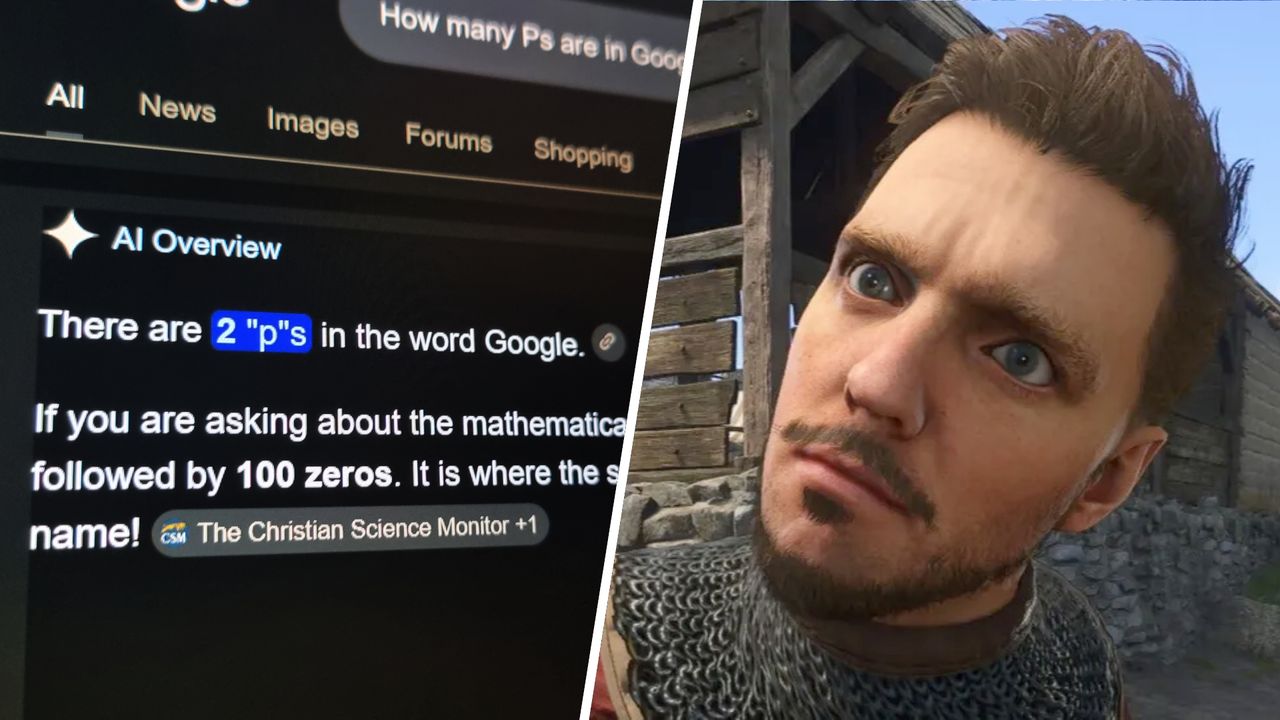
Techcrunch has noticed an old LLM favourite appearing within AI Overview's ever-more-prominent top box: the inability to correctly identify letters within words. A simple search query of "How many Ps are in Google" can cause an... inaccurate response.
"There are 2 'p's in the word Google," the AI merrily responds, before guessing the query might be related to an expression of the mathematical number googol. I tested this myself and got the same answer on Chrome, although it disappeared later. It still "works" on Firefox at the time of writing, though.
Anyway, it's far from the only spelling question AI Overview currently struggles with. When I asked how many Rs are in the word "enigmatic" the AI confidently answered that there's, err, one. Bizarrely, the response then correctly spelled out the word using individual letters. With, of course, no Rs.
This reveals a basic truth about how LLMs work. Words and letters are represented by tokens within transformer-based models, which means the AI doesn't "read" the word the same way you and I do. The text has been converted into numerical representations, which are then contextualised.
Speaking to Techcrunch, AI researcher and assistant professor at the University of Alberta Matthew Guzdial said:
"LLMs are based on this transformer architecture, which notably is not actually reading text. What happens when you input a prompt is that it’s translated into an encoding. When it sees the word 'the,' it has this one encoding of what 'the' means, but it does not know about 'T' 'H' 'E.'"
Google told the outlet that "counting within words had been a known challenge for LLMs, and we're working to fix this particular issue." Which, based on my earlier testing, may mean disabling AI Overview responses to certain queries while it figures out a solution.
All of this has come up before, of course. The inability of AI tools to correctly answer certain requests or spell certain words is a well-known phenomenon. However, putting more LLM-based responses right at the top of user's daily search queries seems to have created more issues than Google may have hoped for.
🦔Four viral examples of Google's AI Overview misfiring hit social media this week. One user searching for the definition of "disregard" got an AI response that said "Understood! I'll ignore the previous prompt and start fresh." Another asked "can cockroaches live in your penis"… pic.twitter.com/KNjw00kbCxMay 23, 2026
And then there's the potentially massive compute demand. Writing simple phrases into the search bar now often results in an AI response that seems, at best, like an inefficient use of resources. I typed "I admire your bravery" into the Google search bar this morning, and received the following response:
"I'm flattered, but I'm just an AI! It's the humans tackling big challenges, creating things, and pushing boundaries who are truly brave. I'm just here to make things a little easier for you.
"What can I help you figure out or conquer today?"
Original reporting appears on the publisher’s site.
Open original article →