
Koorui 34E6UC review
When it comes to gaming monitors, it feels like 2026 has been all about lording it with a long list of OLED displays. So, it's nice to be back among the proletariat with a mere LCD panel. I give you the Koorui 34E6UC.Of course, this is a 34-inch ultrawide model, which is one of my favourite form factors and pretty gene...
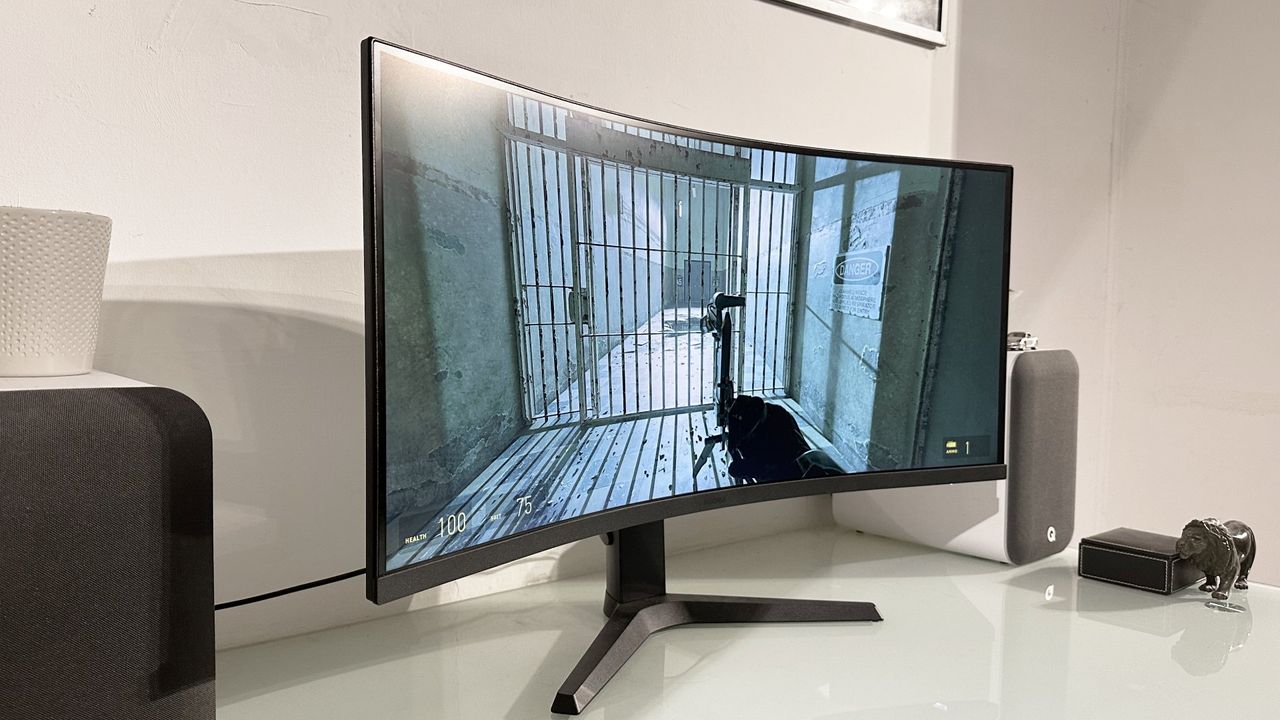
When it comes to gaming monitors, it feels like 2026 has been all about lording it with a long list of OLED displays. So, it's nice to be back among the proletariat with a mere LCD panel. I give you the Koorui 34E6UC.
Of course, this is a 34-inch ultrawide model, which is one of my favourite form factors and pretty generously proportioned. So, the Koorui 34E6UC isn't a truly poverty-spec display. It's just the panel tech is pretty pedestrian and the price positively punchy. There's no mini-LED backlight, no full-array dimming. Just plain old VA running at 165 Hz.
So the appeal here is that, at the time of writing, you can snag this 34 incher on Amazon for just $264 in the US or £199 in the UK. That's far less than you'd pay for an equivalent OLED monitor and, frankly, looks downright reasonable compared to many PC components of late, the prices of which are spiralling out of reach thanks to the AI bubble.
MPG 322UR X24 specsScreen size
34-inch, 1000R
Resolution
3,440 x 1,440
Brightness
400 nits
Response time
1 ms MPRT
Refresh rate
165 Hz
HDR
DisplayHDR 400
Features
VA panel, adaptive sync, 2x HDMI 2.0, DisplayPort 1.2
Price
Buy if...✅ You want an affordable ultrawide experience: 34-inch ultrawide is one of our favourite form factors for immersive gaming combined with acceptable GPU load.
Don't buy if...❌ You're sensitive to pixel speed: Thanks to its VA panel, this monitor's most obvious weakness is relatively poor pixel response times.
The other issue of interest here is Koorui itself. It's very much a lesser known brand, but part of a large Chinese corporation known as HKC that specialises in display semiconductor tech. So, the question is, can you add Koorui to your list of monitor brands that generally make decent displays?
Hold that thought while we cover off the main speeds and feeds. Aside from the 34-inch ultrawide proportions based on a VA-type LCD panel, you're getting the familiar 3,440 by 1,440 resolution, 165 Hz refresh, and claimed 1 ms pixel response performance. For the record, brightness is pegged at 400 nits and there's basic VESA DisplayHDR 400 certification.
Perhaps ill-advisedly, Koorui actually calls out esports as a primary remit for this panel. But here in 2026, 165 Hz isn't really the stuff of online domination. And, in any case, if you're really into esports, you're probably not going to be gaming with an ultrawide monitor.
Elsewhere, you get DisplayPort, plus two HDMI inputs. Just note the latter two top out at 100 Hz, so you'll need to use DisplayPort to get the full 165 Hz. Unsurprisingly given the value positioning, there's no USB-C and no USB-A hub.
Oh, and the stand offers height, tilt and swivel adjustments, plus the chassis is actually as well made as more expensive brands. So, at least no corners have been cut there.
That 34-inch panel, meanwhile, sports a fairly gentle 1000R curve and a matte anti-glare panel coating. So, it's all pretty conventional. Which is no bad thing. Ultimately, this monitor looks pretty sweet, on paper, for the money. But is it actually any good in practice?
VA has worse viewing angles than IPS, so there's a bit of glow at the top and bottom of the panel when viewing dark backgrounds or gaming scenes.
Initial impressions are indeed thoroughly conventional, which is mostly for the better. This is a VA panel with 3,000:1 static contrast, so it blocks a bit more light and offers better black levels than a similar IPS screen.
The slight catch is that VA has worse viewing angles than IPS, so there's a bit of glow at the top and bottom of the panel when viewing dark backgrounds or gaming scenes. It's not a major problem, but it is one of many reminders that you're not looking at an OLED panel.
Still, it's certainly pretty punchy and also well calibrated in both sRGB and DCI-P3 modes, presets for which, incidentally, are provided in the OSD menu. Again, so far, so reassuringly similar to more familiar brands.
Where things are less impressive involves pixel response. VA panels obviously have a reputation for offering the worst pixel response of the major LCD panel types, which also include TN and IPS. Unfortunately, the Koorui 34E6U does little to dispel that notion.
You do get the option of three different levels of pixel overdrive in the OSD menu. But even set to the most aggressive mode, there's a fair amount of blur and smear visible in certain situations.
Exactly how much of an issue that is, well, that's a subjective call. It'll depend to a some degree on your frame of reference. Personally, coming from a series of OLED reviews, the in-game blurriness as you whip your mouse around was all too obvious.
In, say, a brighter Counter-Strike 2 map like Dust 2, the response and clarity is reasonable.
That's especially true, actually, when playing more demanding games at lower refresh rates. Darker game scenes are the worst, suffering quite a bit of visible smear. However in, say, a brighter Counter-Strike 2 map like Dust 2 at native resolution, you can reach the panel's 165 Hz refresh with a fairly modest GPU and the clarity in that scenario is reasonable.
More to the point, none of this is out of the ordinary for this type of display. By way of example, it's about the same as the ASRock Phantom PG34WQ15R2B, which I rated pretty highly. Of course, I rated that screen pretty highly back in early 2023. So, what you're getting is pretty much the same experience, just for $100 less.
In the end, then, this screen is all about context and value. Put it up next to the latest OLED panels, and the shortcomings in terms of contrast, black levels, lighting control, viewing angles, pixel response, and more are pretty stark. But they're also pretty irrelevant if your budget is $250, or thereabouts.
At that price point, the Koorui 34E6UC is a decent effort and definitely buyable. Long story short, this kind of VA panel has weaknesses. But they're not specific to this particular monitor, which is generally well executed. All I would say is that if you can find a good 34-inch ultrawide with an IPS panel for not too huge a premium and you can afford the step up, that would be clearly preferable just for the pixel response.
It's great that you can get a decent 34-inch ultrawide experience for this kind of money.
I can't help but point out that you can also get a 27-inch high-refresh 4K IPS monitor for about $300 these days, too. But if $264 is already a stretch, and it's 34-inch ultrawide you want—and it certainly is a compelling form factor and a good fit with a reasonably attainable graphics card—this Koorui offering ain't half bad.
Indeed, in the current context, what with RAM prices going into orbit and GPUs increasingly costing more than their weight in unobtainium, gaming monitors are one of the few vaguely affordable PC component categories. So, it's great that you can get a decent 34-inch ultrawide experience for this kind of money, it really is.
Finally, on the broader question of Koorui as a monitor brand, the signs are positive from this first viewing. They're backed by a large Chinese corporate and this monitor is covered by a three-year warranty, much like the more familiar competition.
I'd also go so far as to say the simple fact the Koorui reached out to us seeking a review is a sign of a company that wants to engage with western markets, as is the fact that the company runs both US and UK websites with ecommerce facilities where you can order their monitors. Obviously I'd want to see a decent range of Koorui monitor models first hand to give a really authoritative recommendation in that regard. But I like what I've seen so far.
Original reporting appears on the publisher’s site.
Open original article →