
Google Earth let me turn my hometown into a warzone with AI prompts, and the misinformation possibilities are disturbing
Another day, another step towards an AI dystopia. Google has just added a "fun" new feature to Google Earth—Nano Banana 2, the company's image creation tool. All you need to do is click on the "create image" button, type in a prompt, and seconds later you'll have a phony picture masquerading as a real satellite and aer...
Another day, another step towards an AI dystopia. Google has just added a "fun" new feature to Google Earth—Nano Banana 2, the company's image creation tool. All you need to do is click on the "create image" button, type in a prompt, and seconds later you'll have a phony picture masquerading as a real satellite and aerial image from Google Earth.
Once upon a time I would have found this ludicrous—that a tool designed to accurately showcase our planet would be touting a feature that lets you make up absolute nonsense. But now we live in a world where the most popular search engine regularly makes up lies.
For a while, Google was convinced I was married, possibly because I, at one point, mentioned my character having a wife in Crusader Kings 3. At least this was largely harmless—but Google's AI summaries regularly hallucinate and misinterprets things, to the point that it cannot be trusted at all.
Manufacturing warzones, riots, crimes—these are less harmless. But Google Earth now lets you create whatever slop you want. This morning, I asked Google Earth to generate an image of tanks and troops moving down a street near my home. I did not save the image, because I have no intention of putting something on the internet that could be used for some nefarious purpose. But feel free to try it for yourself.
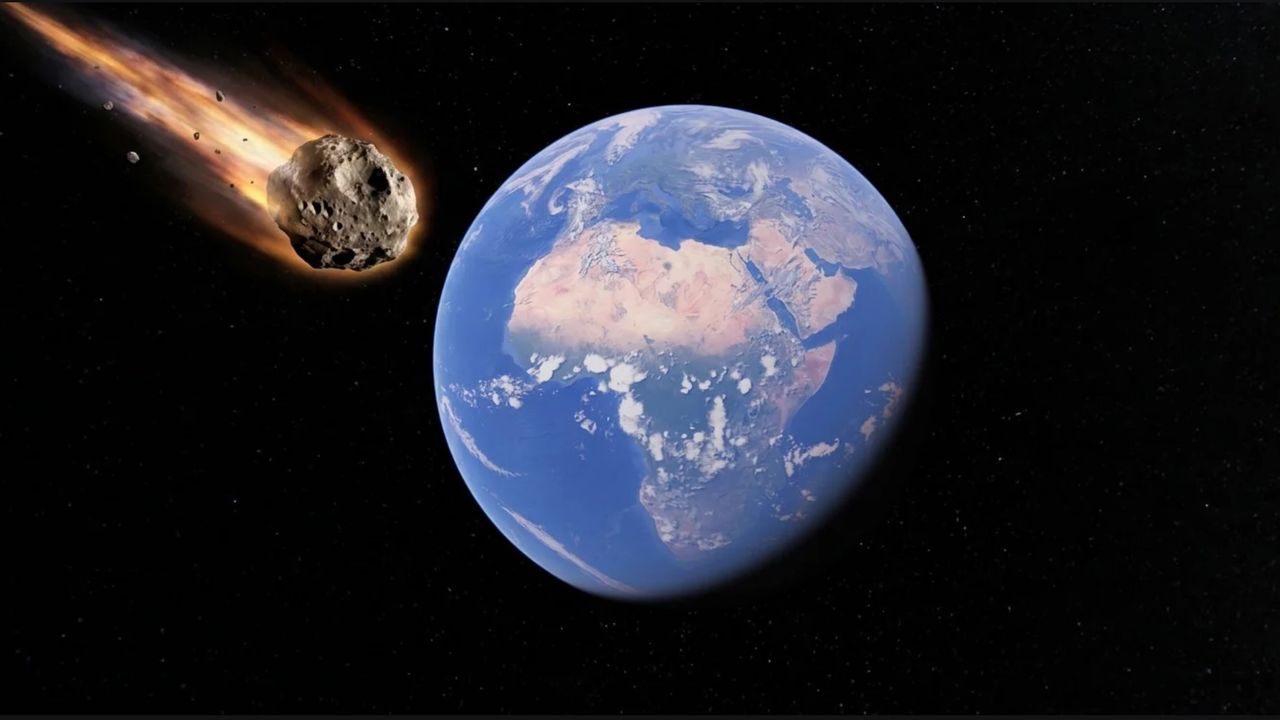
I should add that the image Google Earth created for me was not particularly realistic. Some of the tanks, for instance, were as large as buildings. And nobody is going to look at the header image I generated via Google Earth for this article and think "Oh god, an asteroid is hurtling towards us!" AI image creation is inconsistent at best. But Google realises this, which is why it lets you add more prompts to refine the image—to make it as realistic as possible.
Since the feature went live, I've seen plenty of images that, without knowing about Nano Banana 2's integration, look pretty convincing. Digital Digging's Henk van Ess created an image of refugees massing at the Mexican border, which looked troublingly real.
It's easy to see how this tool could be used for propaganda and misinformation, to drum up hate and stoke fears. Google presents the tool as this cute wee thing that will let you add community gardens to abandoned plots or recreate ancient Pompeii, before the eruption of Vesuvius. That's not how it's going to be used.
Google actually responded to the Digital Digging article on X. Here's what it had to say:
We take misinformation seriously – every image created with Nano Banana in Google Earth includes the SynthID digital watermark, so if someone is unsure about an image, they can ask the Gemini app or use Lens in Search to see if the image was AI-generated. In addition, we prevent…July 31, 2026
This is weak.
OK, yes, Google Earth includes a SynthID digital watermark. So, as per usual, you can use AI tools to identify an AI image. But this is an abduction of responsibility. We're the ones who have to figure out if something is fake or not. Using Google's tools to do it.
As van Hess points out, this is only helpful if the image reaches you unaltered through Google. He ran a clip of him creating the Mexican refugee image through the AI detection tool Hive. It was 99.2% certain the image was real. Because it was real, in the sense that the recording of van Ess creating the image was legit.
So it's pretty easy to bypass detection tools. And yeah, some savvy people will immediately be suspicious unless they can see the original image. Most people don't have time for that. They will have an immediate reaction. And then share it all over social media, where more people will fall for it. By the time it's outed as fake, the damage may have already been done. And the people who fell for it won't be going back to double check.
What about the second part of Google's tweet? "In addition, we prevent image creation on harmful topics and are continually updating our protections." I turned my hometown into a warzone. That's not a bit of fun. That could be harmful. But Google Earth created this image in seconds. Is pretending that there's a vast gathering of refugees waiting at the Mexican border also just a bit of harmless fun? How about a bombed hospital in Gaza, or a nuclear plant in Iran? All three were created by van Ess.
Sure, people can use all sorts of AI image creation tools to make fakes like this. But people are more likely to give them weight when they clearly come from Google Earth—a tool that we've been trained to trust.
This is one of the most powerful, influential companies on the planet not just peddling lies, but giving the whole planet the tools to create their own fun little bits of misinformation.
The only comfort is that, naturally, Google wants to monetise this. Regular users will only be able to make a couple of images a day, reducing how much chaos they can sow, and potentially stopping them from being able to refine images to make them as realistic as possible. So casual trolls will be pretty limited in what they can do. But there is a free trial for new Google Cloud users, and the $75-$150 per month cost won't matter to the more dedicated propagandists.
This sucks, and I am so, so tired.
2026 games: All the upcoming games
Best PC games: Our all-time favorites
Free PC games: Freebie fest
Best FPS games: Finest gunplay
Best RPGs: Grand adventures
Best co-op games: Better together
Original reporting appears on the publisher’s site.
Open original article →
